

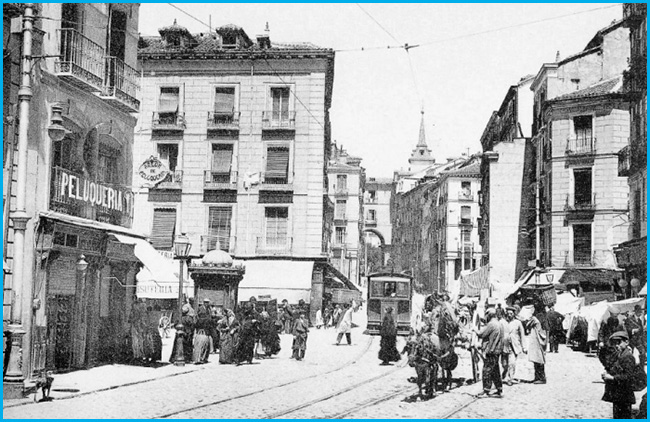
Calle Toledo is one of the most important streets of the centre of Madrid. However, we must point out that right from the very beginning it became a reference point as it was the entrance into Madrid for merchants, farmers and peasants.
Moreover, it was also the old path to get to the town of Toledo. Calle Toledo is not only a street, it is also the living history of Madrid. In the olden times, Calle Toledo was the point of entry for merchants and farmers who brought their products to sell in Madrid. A few weeks ago, we wrote about Mercado de la Cebada, where we mentioned that some centuries ago this market was a reference point in Madrid. We must stress the fact that Mercado de la Cebada is very much linked to Calle Toledo because the merchants and farmers came to Madrid along Calle Toledo to finally reach Mercado de la Cebada where they sold their products. Today, we will go along Calle Toledo and we will delve into old photographs so as to see what it was like decades ago. We have already visited the old Flea Market, El Rastro. Today, our Walk into the Past will take us along Calle Toledo.
CALLE TOLEDO: A KEY STREET
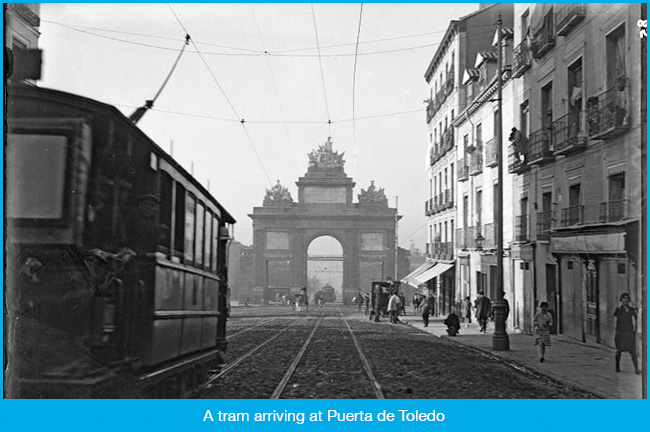
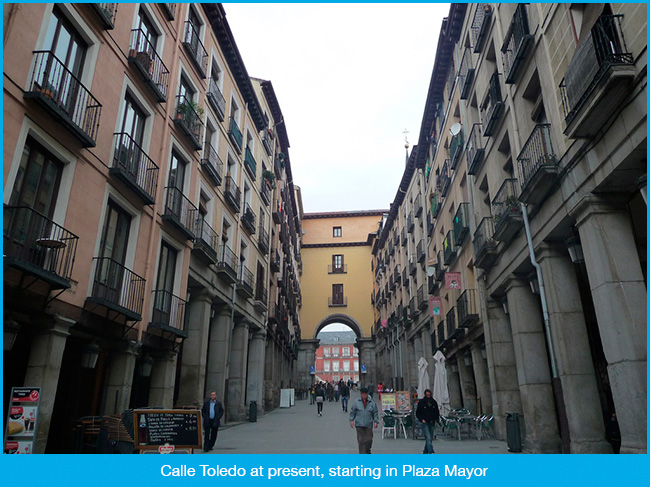
Calle Toledo starts in Arco de Cofreros in Plaza Mayor and ends in Glorieta de Pirámides. It passes in front of Puerta de Toledo which is an icon of this street as well as of the city of Madrid. In 1815, the book Paseo por Madrid, described this street in great detail.
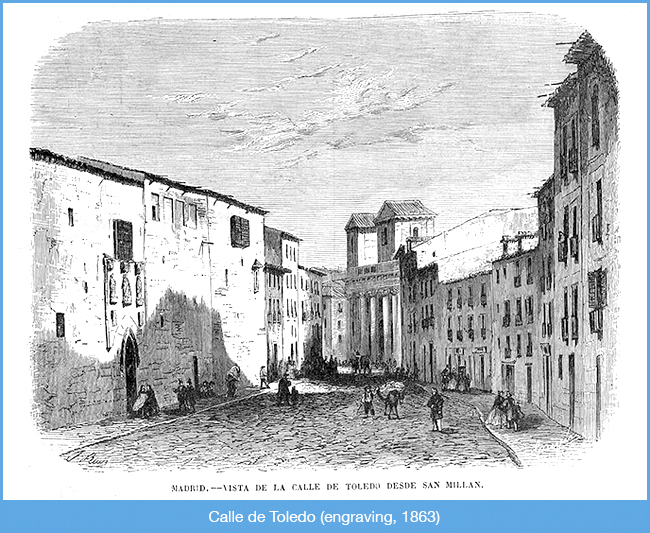
In Calle Toledo and the nearby streets such as Cava Alta and Cava Baja, the great number of taverns and inns attract tourists´attention. These were strategically located so that the merchants who came into Madrid along Calle Toledo would visit them.
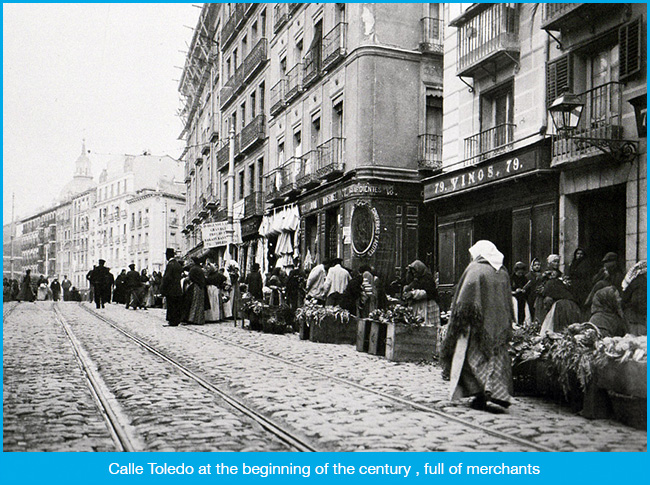
It was a very important street because the main products which were sold in Madrid came in through there.
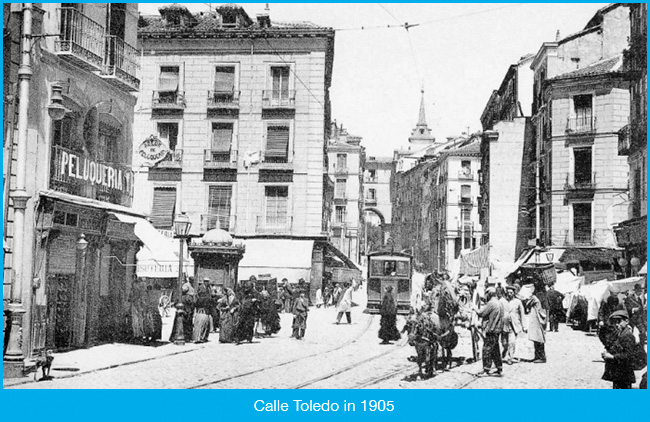
Nowadays, we are still able to see centenary shops which fill us with awe , such as two pharmacies, a shoe shop, a sweet shop and one which sells ropes, strings and cords.
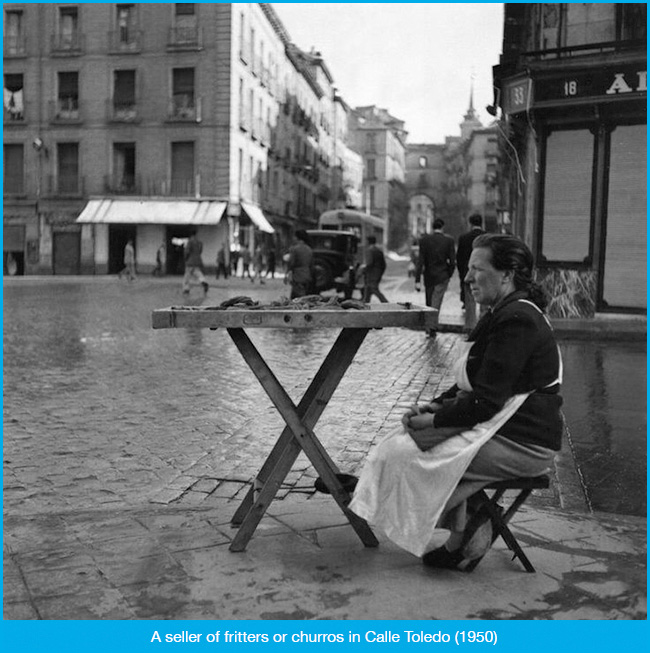
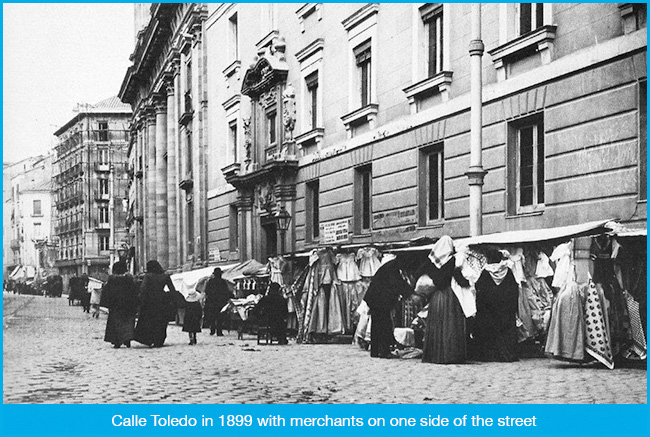
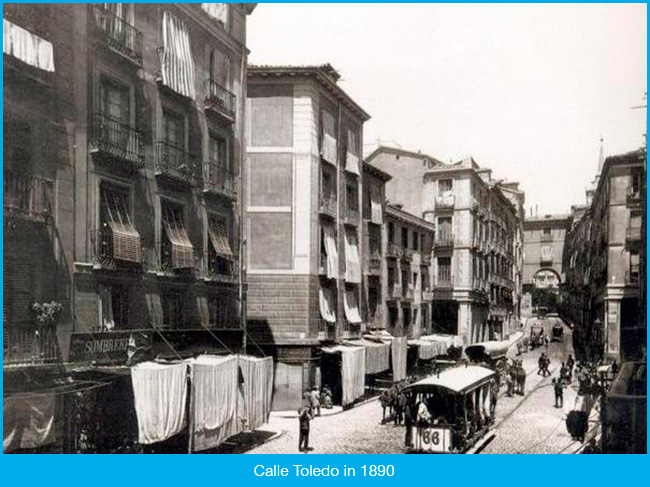
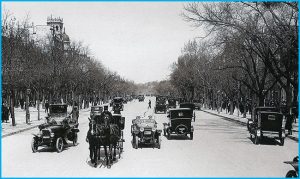
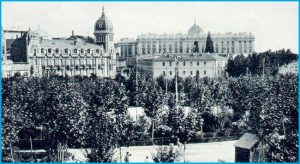
When we look at the old photographs it strikes us that the tram rails and the cobbled pavements have disappeared. As can be seen in these old photographs, the street used to be crowded with merchants who sold their products to passers-by and pedestrians.
TWO HISTORIC BUILDINGS
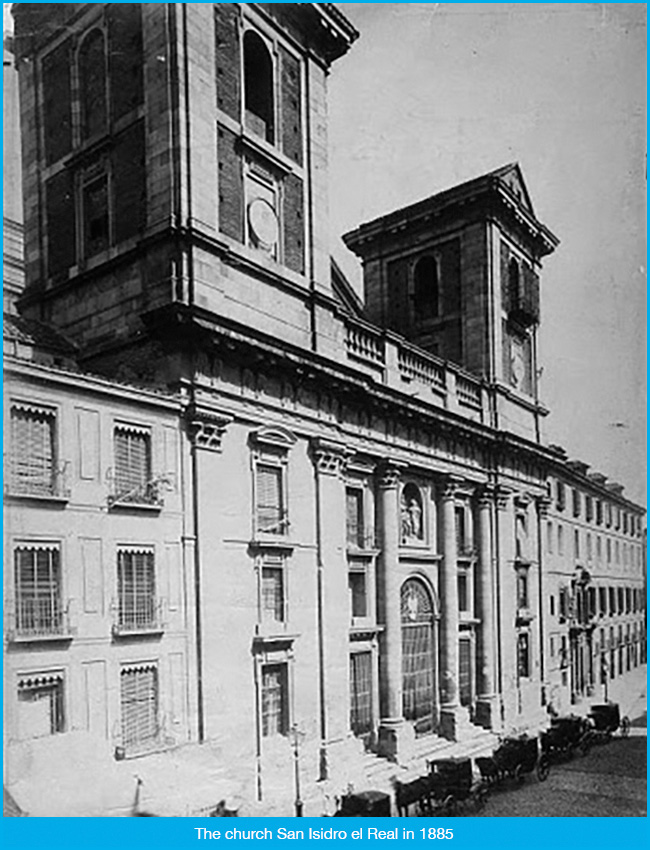
Two historic buildings were located in Calle Toledo: in number 33, Real Colegiata de San Isidro (1620), and in number 39, Reales Estudios de San Isidro founded by Felipe IV in 1625. Real Colegiata de San Isidro was the cathedral of Madrid till 1993 when La Almudena became the definite cathedral of the city. Regarding Reales Estudios de San Isidro, we can still see part of its façade and structure. In its place stands Instituto de Enseñanza Secundaria San Isidro.
DID YOU KNOW THAT…?
Calle Toledo was not always called so. For a long time it was known as Paseo de los Ocho Hilos due to the beautiful trees that lined it and which had been planted forming eight rows. However, the most curious name it had was Calle de la Mancebía which dates back to the XIV century and whose origin was related to a brothel in the area.
Picture 01: El Museo Universal
Pictures 02, 04 and 05: Madrid Antiguo
Pictures 03 and 06: Secretos de Madrid
Nowadays picture: pegatina1
 Spanish
 English